Building community through the love of Christ
ABOUT US
WHO WE ARE
We proclaim the all-embracing love of Jesus Christ. Our church is inclusive where all are welcome, whether joyful, hurting, confident or doubting. We journey alongside all faiths and none as we seek to act justly, love mercy and walk humbly with God, guided by the Holy Spirit.
A PROFILE OF THE UNITED CHURCH
 This supports understanding who we are and what’s important to us. It sets out the qualities we hold to be important in our church leaders (including future ministers), both existing leaders and those considering joining us in the future.
Read the profile here.
This supports understanding who we are and what’s important to us. It sets out the qualities we hold to be important in our church leaders (including future ministers), both existing leaders and those considering joining us in the future.
OUR VISION
Read the Vision and Mission Commitments of the United Church here.
This includes ways in which we are working to make these commitments real through worship and mission activity, in our church and local community.
Read an example of our innovative community outreach work; the People’s Piano here.
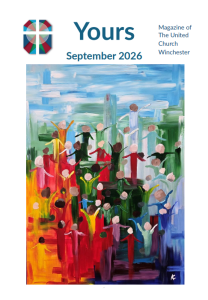 And here is a recent example of our church magazine ‘YOURS’. This reflects a rich and varied church community, with a broad range of interests and thinking. All contributed by members (and a former member) of the United Church.
All editions of YOURS can be found here.
Our Church Leaflet – available in the Coffee Bar
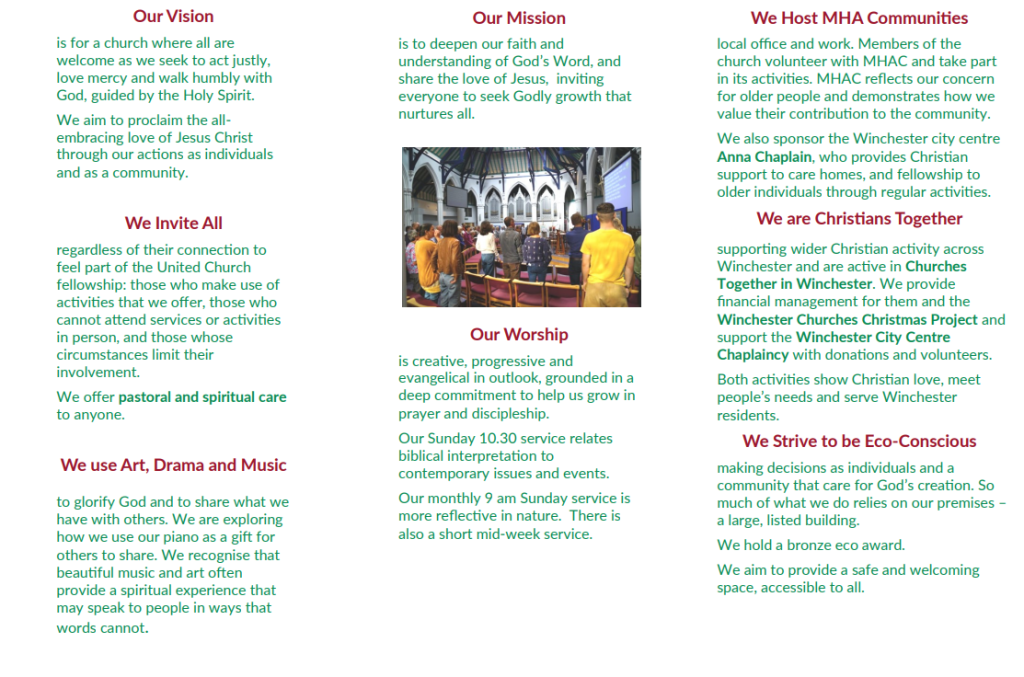
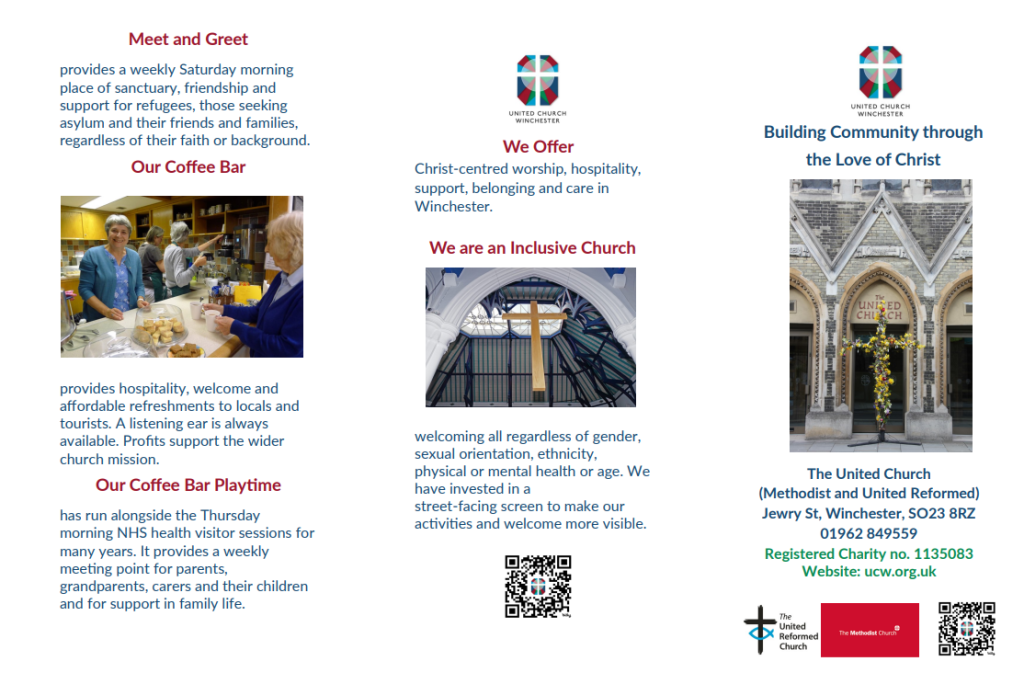
This includes ways in which we are working to make these commitments real through worship and mission activity, in our church and local community.
And here is a recent example of our church magazine ‘YOURS’. This reflects a rich and varied church community, with a broad range of interests and thinking. All contributed by members (and a former member) of the United Church.
YOURS MAGAZINE
Please select a month below to view:
OUR HISTORY
First of all, it was on Sunday 8 September 1974 that The United Church celebrated its formation. Therefore, a special service was held at which representatives of the City, the Methodist District and the URC Synod were present.
During the early 1970s, the Winchester Methodist churches began to work closely with the United Reformed Church in Jewry Street. So, after lengthy discussions led by the ministers, the Revd Wallace White (Methodist) and the Revd David James (URC), consequently the congregations resolved to unite in one set of premises.
Due to the Jewry Street building being the largest of the three it was chosen, also in view of its position to effectively connect with the life of the city. A key aspect of the agreement was to seek a redevelopment of the building. After several false starts and much negotiation and fund-raising, this finally took place between 1989–91.
See the Wikipedia page on the United Church here.
Due to the Jewry Street building being the largest of the three it was chosen, also in view of its position to effectively connect with the life of the city. A key aspect of the agreement was to seek a redevelopment of the building. After several false starts and much negotiation and fund-raising, this finally took place between 1989–91.
See the Wikipedia page on the United Church here.